Monday, August 18, 2014

Ferguson Opinion piece


Growing distrust between the local police and Ferguson citizens convolute the matters in the Missouri town.
                Recently in news the most publicized example of civil unrest is being dissected in as many ways as every educated individual can possibly understand the event. However,  these angles have over-arching themes.
                With the first appearance of media coverage of the many events in Ferguson, it is simple to see emerging themes of Race, police brutality, civil and uncivil protest. But, as a developing story it quickly became convoluted as media dissected it.
                Police reaction to the documentation of the unfolding events in Ferguson certainly did complicate the issues. The arrests of Ryan Reilly of the Huffington Post and Wesley Lowery of the Washington post was not the way to calm flaring distrust in Ferguson.
                These accounts, which are receiving nation-wide coverage only serve to convict the police of not keeping civil peace but complicating the solution and distrust in Ferguson.
                To conclude the most recent series of events the police released the officer’s name that shot Michael Brown. Shortly afterwards, police released information stating Michael Brown is a suspect in a convenient store robbery. The timing of the release raises questions about the motives of the local police.

                The accounts of police activity practically reek of racketeering. However, in light of Browns culpability, Police brutality, civil unrest, racial profiling, un-lawful arrests, media coverage, and homicide of an 18yr. old man, it’s a little more complicated than that…isn’t it?

Saturday, May 25, 2013

"Albinicide" Feature story


               My time in Tanzania didn't just take me to a variety of different places, it took to a variety of different people. It was while my swahili intensive group and I were visiting an all women co-op that I met an albino woman by the name of Martha Mganga. This woman told us about the killings of albino people in East Africa. After hearing about this horriffic phenomenon and being touched by her personal story of struggle, I wanted to lend my hand to the awareness of the of The East African albino. Here is the feature story I did on what has been coined as "Albinicide" after hearing her testimony:
  People hold pieces of albino anatomy like we hold rabbit feet," Kelly Askew, director of African studies at the University of Michigan explained.

Many may ask what kind of luck harvesting albino anatomy could bring? “This luck is relative to natural resources,” Mrs. Askew continued, “this marks the end of socialism and the movement into a free market and capitalism in East Africa.”
This East African phenomenon is termed “Albinicide” by U of M Grad student, Menan Jangu. Albinicide is perpetuated by competition between local and international businesses that race for natural resources.[1] 
 Albinicide is “a symptom of structural, socioeconomic and cultural forms that make people with albinism vulnerable to physical violence” as defined by Jangu. Because local businesses, such as fishermen and miners popular to the western side of East Africa, can’t compete with the cutting edge technologies of international businesses in the recently introduced free market, they seek albino anatomy to level the playing field.
Jangu explains, myths perpetrated by “mgangas,” people who generally practice traditional medicine, warrant the harvest of albino limbs, blood, and organs promising luck and wealth obtained from the help of charms and potions. However, there is a discourse surrounding albino killings which conflates witchcraft with traditional healing.
The role of mgangas, Mrs.Askew elaborates, in East African Culture is historically helpful, supplementing the paucity of health care systems which often struggle to provide to an overwhelming populace with herbal medicine.
  However, “Utapeli,” con men or racketeers who claim to practice medicine are often the perpetrators of these rumors which could explain the circulation of such rumors and myths
To complicate matters; Gov’t aid is limited in a variety of ways, making support difficult.
 “There is an excessive influx of people from rural to urban areas in search of better life opportunities. Oftentimes, a typical African city's infrastructures and amenities, such as water supply, electricity, hospitals, police services, fire services, residential homes, jobs, etc. can hardly meet the rate of demand for their services” Victor Okafor, head of Africology & African American Studies at Eastern Michigan said.
“For instance, a water supply system built for a projected population of 250,000 may end up being depended upon by a city that may have reached an explosive population size of perhaps 500,000 or more” Okafor Continued.
Many East African Laws limit aid to albinos further; “In order to convict a person practicing witchcraft, an accused individual must be apprehended at the crime scene. This rarely happens because witchcraft acts are undertaken in secrecy.” Furthermore, “Witchcraft is not clearly defined in the Witchcraft Act and the Act does not account for actions related to witchcraft” Jangu explained
                 In light of the problematic nature of Albonicide on the basis of Government aid, independent groups have surfaced in defense of the albino populations of East African Countries.
Groups and charities such as “Under the Same Sun” act as havens for albinos. Groups like Asante Marimau provide skin care products, clothes, and shelter for albinos who more often than not are too poor to provide any of these life-saving amenities for themselves.
The plea of the East African Albino population is gaining international attention. Raising awareness of the dire situation albinos face has become the goal of many international organizations.
Projects such as “Endagered White,” an exhibition by Yrneh Gabon Brown, have surfaced in order to combat the social ignorance.
“More than 100 albinos have been violently attacked in Tanzania from 2006 to June of this year — 71 died and 31 escaped, though most were maimed,” reported John Burnett of NPR in 2012. However, it is likely the percentage of attacks that are reported pale in comparison to the number of actual attacks.


Feature story on the internationally acknowledged Zanzibari Farouque Abdella

While the Swahili Intesnsive group and I were touring Zanzibar one afternoon I had the luck to run into one of the Islands historic figures Farouque Abdella known for exposing the world to


East African fashion and design. The following is the feauture story I wrote on him after I had the pleasure of Interviewing the "2nd wonder of  Zanizibar" ( the first being a museum actually named the House of Wonders)

My interview with Farouque courtesy of  Mrs. Askew
Looking down on the Indian Ocean as the sun rose from its depths, Farouque Abdela, the self-proclaimed   “2nd wonder of Zanzibar” leered from his sun glasses atop the porch of his shop in Zanzibar. As if he was turning back time himself, the fourth generation tailor from a family of the like lit a cigarette exuberating the pride that comes from pioneers of innovation.

 His method of using recycled items such as sacks, plastic bags, and other litter as material for his designs serves as a precursor for Abdela’s innovative methodology.

                Beyond Abdella’s “green” approach, His work takes a spin on Masai and Egyptian culture and design. ”I believe there is a link between the Masai and the Eqyptians” Abdella explained. His work is heavily influenced by these two cultures.

                “Their physical features and style of dress captivates me, but it’s also about preserving the culture, I admire the Masai Tribes’ preservation of their culture through-out the era of colonism”. However, Abdela himself has been involved, all his life, in preserving the initially neglected fashion and culture of East Africa.

As a kid Abdela was kept busy with tailoring tasks, he explained. Being born into tailoring he recalls how he and his three brothers were called upon to help their father in his tailoring “If we wanted something from our father we worked for it” Abdella said as he put out his cigarette.

 During the Zanzibari revolution in 1964 his family left. It was then Abdella enrolled into the London College of fashion.

In his college years Farouque was introduced to people of many different back-rounds and life styles.

                 “Through this exposure to such varieties of people I gained a diversified perspective” Abdella explained, as children ran up his porch holding out their hands to him, Farouque pulled out a few pieces of hard candy and handed it to them one by one before they jetted off. It was also in school that Abdela made many of the relationships that would aid him in his later endeavors.

After graduating Farouque enveloped himself in his work and his efforts did not go unnoticed, in 1999 he was invited to return to Zanzibar for its film festival to do a fashion show.

While in Zanzibar Abdela was also called upon to aid the Zanzibar Association of People Living with AIDS (ZAPLA). It was in this group that his networking allowed him to create funding and infrastructure Abdella explained. “This was the beginning of my group coordinating and my most successful charity event, among a few others”

More recently Abdela‘s involves himself with Albinism awareness, down syndrome charity, and cleaning up the environment “The bad, you can turn into good” He said.

At the Height of his career Abdela was requested to showcase his work at the Paris Fashion week

“I was practically hysterical” He recalls, “I wanted to make an impact” this was the debut of his Masai design. It was here his work was acknowledged by Princess Diana. “She was a normal person like anyone else” he explained.

Despite the attention and fame that his work created, Abdela experienced his first taste of the racial divide of these times which separated the white designers from him. “I received significantly less coverage than white designers” he explained. Regardless of this sobering experience Abdela recalls his Paris debut as “A life changing experience” this was the moment that changed his self-concept he reminisced as he pulled on his cigarette.

“Afterwards I sought to destroy stigmas, restore self-worth, and individual thinking in my community through my projects and works” Abdella concluded. His works run parallel to the underpinnings of equality and a universal celebration of difference.

Saturday, September 1, 2012

Warning: Animals were harmed in the creation of this Post (days 4 and 5)


After a full night's sleep Chris and I awoke pretty late due to our previous night. Because of this instead of leaving to meet the  first thing in the morning to witness the traditional slaughter of a cow we traveled to Juma's for breakfast. We enjoyed our Chipatis and Chai maziwa then b-lined it to the Illmurran orpul “Warrior encampment” for lunch. We arrived to meet our acquaintances in the midst the disassembling of their cow into chunks of beef. Warriors actually eat these chunks of meat in a particular order which I can’t recall. After the Chunks of meat were organized, we began to roast them piece by piece. We sat in a circle around fire pits after witnessing the Masai profiency with knives and blades. After roasting, one warrior carved the beef and handed a cut to each person in the group, starting from the left in order. I found the beef much more tasteful in comparison to the goat, although, just as chewy.  After we devoured the cow we spent more time bonding with the warriors who were generally younger than us; ages 18 to 20. It turns out that the plan was to have me and Chris to stay with the Illmurran in their encampment for a few days. Shocked at the opportunity I didn’t know what to say, I was nervous, but let the record show I’d be damned if I let a opportunity like that pass me by. After spending most of our afternoon with the Illmurran we departed to hang with more masai in the market place which appeared to be in the middle of nowhere however, every we had come in contact with up until then was here, it was the equivalent a mall in the states. The rest of our day was spent wandering the marketplace and the surrounding area while Mary (Frank’s mother) grinded her corn for Ugali that night. About two hours passed until we were summoned back to the car and may our way back home to Cha Ng’ombe for dinner and a restful evening.
Lenjekka Terroizing a Turtle

The next morning we were told, due to the sighting of lions in the area of warrior encampment, we wouldn’t be allowed to stay. Instead of staying with the Illmurran we would have the chance to create our own Orpul; “warrior camp”, and hang with the elders as well as Frank and the gang. It was a bit of a letdown, I wanted to get a true experience of such a deep rooted tradition of Masai culture, however, being able to return home in one piece also sounded appealing. Without further notice Juma, Lenjekka, frank and Papaa, took us outside of Frank’s Kraal and helped Chris and I clear the area that would serve as our Orpul. We took an area about 12 yards in diameter and fit shrubbery and tree limbs around it until it was practically closed except for a small entrance on one side which you had to kneel to fit through. We finished and it was time to start dinner.

(from the left Chris, An "Elder", and I in front of our Orpul)
What’s for dinner in our Orpul you ask? Why goat of Course! And being that we are now in warrior training we won’t waste a hair on that lucky goats head! We followed Frank back to his Kraal, he pulls this massive goat from his stock of animals, ties a leash around it, gives the leash to us and we begin to lead the goat out of the Kraal.
 Interestingly enough the second we begin towards our orpul the rest of the goats begin to bleat, calmly at first, but the farther we get the more maddening it begins to sound. It was almost as if these goats knew what was about to happen next.
  By the time we were outside of Franks kraal I didn’t doubt that they did! As soon as we returned the goat was flipped on its side, I held the goat down and Chris did the dirty deed. Placing his hands over the goat’s nose and mouth he suffocated the goat. This goat's demise was significantly more humane then the latter technique I wrote on in previous posts. (My conscious is clean; I practically did nothin- just sayin’) The goat slipped from consciousness, then we turned the goat over on its back to begin skinning it; as I said earlier, nothing would be wasted.

Although , maybe that line is best exemplified by the cup of goat blood we, the elders, and fellow warriors drank during the disassembly of our dinner. After a quick cup of refreshment the elders skillfully and quickly finished preparing the goat for roasting. It was almost festive Warriors and elder hanging out-passing on knife skills and techniques. As I’ve said earlier cuts of meat, traditionally, are ate in a specific order, furthermore with the nature of our roast, certain cuts of meat were reserved for the elders to partake. We sat in two groups circled up, which is actually another tradition for orpul roasts, around fire pits roasting and joking. After we finished dinner the elders, Frank, Juma, and Mrs. Askew left me, Chris Lenjekka, and Papaa to retire in our encampment.
 It was around 9 at night, we placed the remainder our meat on a tree limb and leaf rack we made earlier. Chris and I set up our tent, lenjekka and Papaa laid our their goat skin mats, however it wasn’t bed time, it was time to  bro out; so sacred a tradition there is currently no Swahili or Maa translation . We awoke next morning around 4 or 5 A.M we had been up until about twelve the previous night, playing games and talking about our feelings in Swahili. Although, little did I know the games had just begun…

Friday, August 31, 2012

Day 6-7


Chris and I were awoken in the middle of the night, ok, maybe somewhere at the beginning of the fourth quarter (the most important quarter of sleep, duh) around 4 or 5 A.M.  We painfully woke and arose from our sleep. We were to cook the rest of the goat after starting up the fire pit. We set the goat leg over the flame to roast, the time we spent watching the leg roast was spent in a dream-like state. I know I personally teetered on the edge of consciousness and unconsciousness while watching the flames from the fire dance…around goat leg. We couldn’t see anything beyond our Orpul, beyond the light from the flames there was a sense of nothingness, just us. The four of us sat in a circle watching the flames caress our roast while we waited for the sun to raise.  After forcing chunks of meat to my still sleeping belly I came back to my senses a bit to wash down our food we made some "Nyama Chai" (soup). As the sun rose Chris and I ascended out of the darkeness of the orpul guided by lenjekka and Paapaa in warrior hood. We were ready to face a lion!..but hey insisted otherwise so instead we washed up to wash off the looming fatigue putting an end to our training camp.


a part of the vast spring
We packed up everything we brought out and prepared to wash up around ten o’ clock. After relaxing for a brief moment we were right back at it. Today we were to head to the natural spring where many of the cattle of Lesoit go to drink, to meet with an engineer in the midst of some pipe work.

Some Masai and Chris "Cold Chillin"
Upon arrival many Masai were washing, while cattle drank from the spring, it seemed almost like a getaway from the responsibilities of their Kraals; wives, children, and stock, here they joked and enjoyed the company of their friends. We began touring the springs until it was clear we missed this mysterious engineer. Though we missed the engineer we met up with a bunch of young Masai relaxing watching over their cattle and joined them.
Cattle drinking from a trough
We conversed and kicked it old school, and even had a photo shoot.  It was an uneventful day full of recovery and relaxation, so I thought. While we returned to Cha ng'omobe' we came across a large herd of missing cattle grazing on land which was to be reserved, Chris and I were auspicious enough to get the chance to heard cattle. With the force of synergy unheard of, Frnak, Chris, and I rounded up the cattle and lead them back to the Kraal. Call me lame, but it was really exciting. I was like a boy frollicking between 900 lb cows.
"Epic Cattle Herding"
Chris and I had free time for the rest of the day.  I took this opportunity for adventure Time!!! I figured I’d take the 10 minute walk to the market for water and to test my understanding of my whereabouts. I jogged there in five minutes practicing my Swahili with the locals who were really welcoming. After I bought some bottles of water, I made my way back to Frank’s Kraal only to get lost in the woods and partake in some help from some local peeps. I returned for dinner with the crew and star gazing afterwards. With the end of our seventh day I found the end of my trip finally near. I won’t lie I was home sick, but it wasn’t time to go home just yet, we still had the big soccer game tomorrow!
Here are a few more pics of our experience herding:

Lanjen and I
Chris exhibiting his Herding capabilities


Bossin out with the Masai, Herding.


Thursday, August 23, 2012

Day 8


Little Masai Kid working Chris and I


Corner Kick!
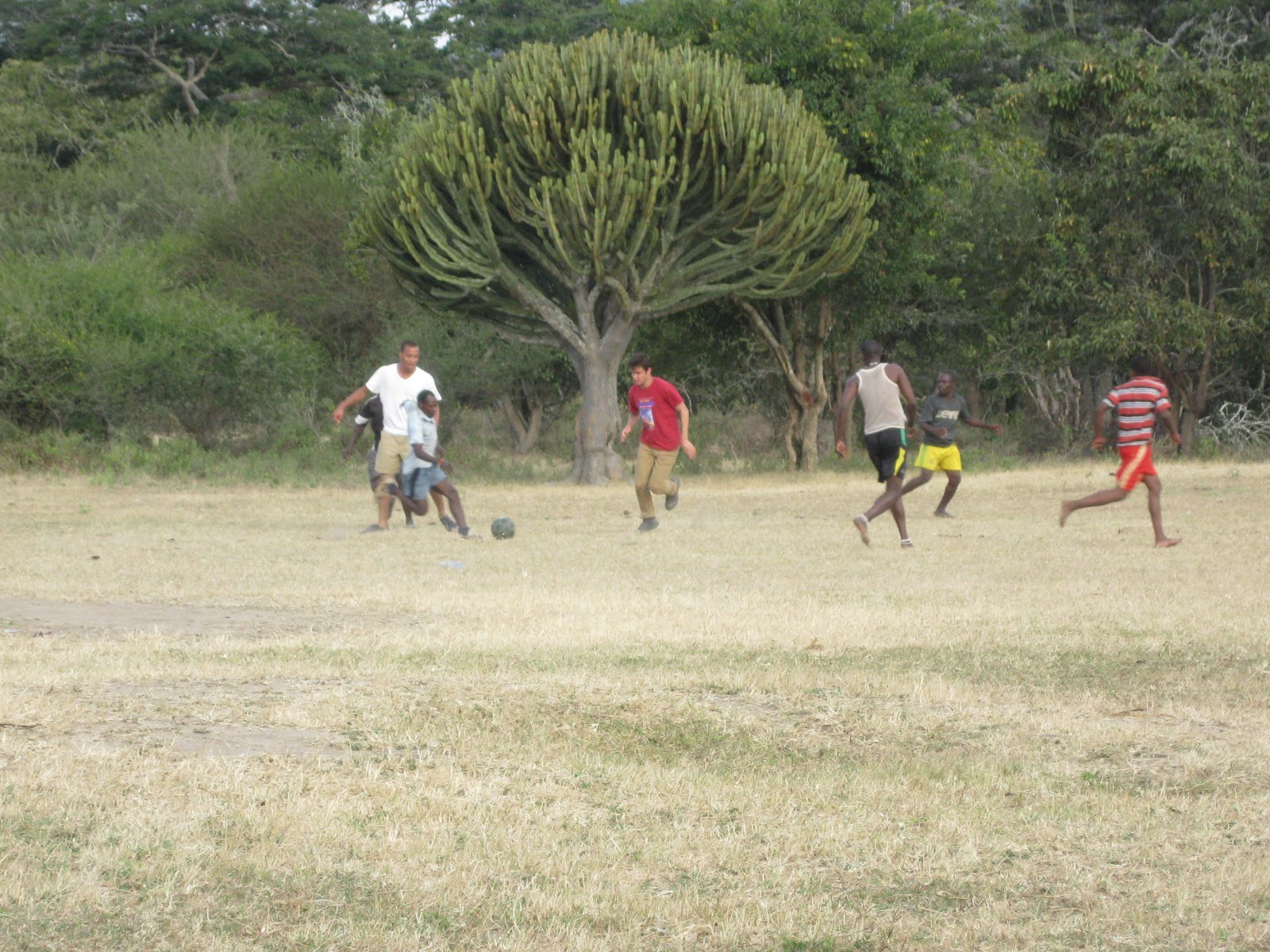
                This was the last day actually recorded in my journal despite the fact that I was actually there for a few more days. I was unusually aware of the approaching departure date as I arose from bed with the sound of the Masai children frolicking outside, as usual. We met up with everyone for mandazi and chai and soon afterwards left breakfast for lunch, as usual. We walked to another Massai’s Kraal for hot milk and conversation while we roasted goat for lunch. By the time we left it was around 3, Mrs. Askew and Frank wanted to check the hot springs again to see if any work had been accomplished but to our dismay, and subtle expectations little had been ostensibly done. We toured around the hot springs again. I tried to take in everything one last time so that just maybe I could never forget this place, or the people. But with the big soccer game approaching we didn’t have long. We departed for what I would almost consider the big finale of my time time Lesoit. We got to the soccer field  around 5 to play six on six.
Frank and I getting ready to score!
 Majority of the players on the field were at about 15 or 16 years old, but we couldn’t keep up with their skill level. It was a great game with Frank, a few of the teachers, a bunch of students, and a few others playing.  We lost that night 2-1.  The sun began to set on Lesoit, despite our loss it felt good to bond with the Masai of Lesoit. Prior to the game tensions were at an all-time high. It was our practice with Swahili which let us defuse the rigidities. Chris and I found our-selves feeling on edge and often in the midst of stare downs with the masai students right before the game, the type of cold stare that’d make you feel unwelcome. But this was just an example of cultural differences.  Mambo?  what’s up?” I’d ask holding out my hand, a large smile would streak across their face as they clutched my hand saying Poa  “Cool” (which was the usual answer in Tanzania). The soccer game served as more than just a field to play.


Wednesday, August 22, 2012

Fin.


My last few days in Lesoit I was introduced to the students Chris would be teaching for the larger remainder of his trip. I traveled to the schools with him early in the morning. These two days would serve as a brief series of summer school sessions. It would be my first time trying my hand at teaching which was all too exciting and interesting being the first days we had to use charcoal for chalk, on a black board, which actually was really effective, that is if you had the right piece of charcoal.


Farewell to my masai friends; Franks Family and friends.
We began to teach them Chemistry, Biology, and Physics. Three subjects which weren’t easy to dive into especially considering our limited skills in Swahili. Although these days were fun; bonding, tutoring, and learning with the students, it was very clear how difficult the days ahead would be for my friend, I had the easy way out, a 18 hour plane trip back to the states in another day.
 
Special Thanks:
Overall, my trip to Tanzania was amazing and ultimately indescribable, though I dedicated this blog to doing so. I owe the amazing time I had in Tanzania to my peers! ; Ali Anger, Bruce Winters, Haley Rademacher, Katie Picket, Brooke Farrell, Kaka Jay, Jessie Fredlund, Molly Ryan, and Laura Damon. Sorry I didn’t write more about you guys! Forgive my Laziness! To my house Mother and Brother Mama Mganga, and Juliuis,


(From the Left): Haley Rademacher, Laura Damon, Brice Winters, Jessie Fredlund, Molly Ryan, Ali Anger, Brooke Farrel, Chris, Myself

 My teachers; Gaudentia Lwakatare, Deo Ngonyani, and Joachim Kisanji Thanks for working through my immaturity! my close friend Chris-let’s grab a drink this weekend!, and finally, last but most certainly not least to Mrs. Askew who I owe the entire trip to. So in my opinion it’s only right that I dedicate this blog to them, who facilitated the sum of my experiences and work during my study abroad, I send my greatest appreciation, Thank you. And thank you all for reading! Stay tuned.

Mwalimu Ngonyani, (sorry Deo, it was th only pic I could find :p)
Kisanji and I


Bwana Bruce and I stuntin'

Kaka Jay


Mwalimu(teacher) Gaude and I


Brooke!


My house mother; mama mganga and I

Jessie and I!

Thursday, August 16, 2012

Day 2 & 3


A local spring we passed during our ascension
The 28th of June, my third day in Lesoit Village (City.) Frank, Juma, and Paapaa planned to take us on a hike up Oldonyo Olosipa (Bald Mountain). We woke up this morning for Chai Maziwa and Chapati, then dawned our shukas and finished preparing for our hike. We departed from Cha’ ngombe (Franks Kraal) in the morning to park a bit outside of the Lesoit city market and began our hike. It was at this time that Chris and I received our fimbos-(Maasai walking sticks carved from African black wood) Juma and Frank gifted their walking sticks to Chris and I.  
The Hike itself was about 45 minutes-one way. As we walked, we passed natural springs and herds of cattle grazing around the base of the mountain.
A herd of Cows grazing
 Juma and Mrs. Askew told us stories of warriors coming face to face with fierce Pythons that could fling themselves into and strike from trees.  After a short while of walking we stumbled upon a clearing. Frank stopped us to show us a few of the games warriors play such as Rungu(club) and Fimbo throwing . He pulled out one of the traditional weapons Maasai warriors are equipped with; the Rungu. Juma then stationed himself at the other end of the clearing, then Frank wound up and threw the rungu clear across the area to land inches away Juma’s feet; something like 80-90 yards. Then it was our turn. He handed me the rungu and positioned me across from Juma, after showing the way to hold the African black wood club I let it whip out of my hands to land a few yards short of Juma. Chris followed suit and positioned himself across the clearing, as he swung his arm the rungu flailed out of his hands and straight into the bush. I made sure to hold my victory over him for the remainder of the hike but, my triumph was short lived, another competition loomed over us as we looked toward the peak of Olosipa. Who would be the first to gaze out over the land of Lesoit?
During our hike we actually ran into an illegal lumbering operation, These men were  illegally harvesting  lumber from the Maasai forests, operations like these are fairly common
  As the summit of Oldonyo olosipa came into view I took no time in attempting to cement a double vicotory and took off in a spint, conquering the increasingly steep slopes, victory insight. I stopped a few yards short of my destination looking down towards Chris to catch my breath and gloat on my impending victory. On this sight Chris shot towards the summit to in a hail mary despite the distance between us. With my strength returned I prepared to finish the distance, but before I could do this, vicious Ants had begun their hike up my right leg!  I remembered the east African saying “when the siafu(Biting ants)  are around everyone is your family “-Those who are inauspicious enough to be swarmed by siafu are advised to strip,  but I refused to strip and pulled each ant off of my leg. While I did this, Chris had summited Olosipa and I received a humbling barrage of teasing from Chris. Truly the worst indigestion comes from ones own words. As Frank, Juma, and Mrs. Askew joined Chris and I we all looked out from our vantage point, amazed at the reaches of Lesoit City rolling mountains and plains dressed the land scape with villages spotted throughout the range.
Mrs. Askew snaps a photo to commemorate the occasion
 After catching our breath and commemorating the event we began to descend Oldonyo Osopina.
Once we returned, we enjoyed a well needed Shower and descended the plateau into Songe to watch the European finals Portugal Vs Spain, the quarterfinals for the night.


06/28 My third day in Lesoit city was spent with the Ilmurran( Warriors). Chris and I were initially invited the morning of the 28th to witness our first Cow slaughter, but due to our late night we arrived at Juma’s kraal-Kati to eat breakfast with his family. Afterwards we traveled to the Orpul -(Warrior encampment) late morning  to meet the Ilmurran. Chris and I separated from the rest of the gang and were led into the warrior encampment, where we roasted meat and became acquainted with them. After the roasted beef and some small talk we were escorted by the Illmurran back to Juma’s village. On the way back we joked and conversed a bit more to gauge the possibility of Chris and I staying in the Orpul, and if so, how long? The warriors spoke Maa (their first language) were fluent in Swahilli (Tanzania’s national language), and spoke some fractured English. Communicating with them didn’t prove difficult with Chris’s and my own mastery of “swanglish”. Once we returned to Mrs. Askew and the rest of the gang, we spoke on some of the details concerning our stay with the warriors. Now despite the common understanding that Chris and my own combined physique and raw manliness would have no trouble dealing with a lion, there had been sightings of lions in the area and there was the question of reliable water sources. Unfortunately, it was resolved that Chris and I would construct our own Orpul with the help of Paapaa, Lenjekka(Franks younger brother), Frank, Juma and a few others. We would begin in the morning! The remainder of the afternoon was spent mingling in Cha’ ngombe, working on our Maa, and relaxing.  In the evening we made another excursion to Songe to see the semi-finals between Germany and Italy, (2-1) Italy, at a local bar. During our descents to Songe, Chris and I found ourselves traveling to a Michael Jackson's “Greatest Hits” album. Our car, toughing the rough terrain in the middle of a pitch black forest, jamming out to P.Y.T. It had turned out Frank was a huge Michael Jackson fan.


Wednesday, August 15, 2012

Arrival in Lesoit Village(city)


After a full day of driving we arrived at Lesoit(City) village. During the trip Mrs. Askew taught us how to greet in Maa. So after a little practice during the trip I exited the car into the pitch black, moonless night to be greeted by tall dark silhouettes.  I Crashed and burn my Maa entrance exam, but the rest of greetings were said in Swahili. We all sat outside the Maasai Boma (house) Chris and I would live in for the following two weeks and drank chai maziwa; A milk based black tea lightly spiced with cardamom and ginger I think. As we drank tea Chris and I were acquainted with Paapaa, Juma, Mary and a few others that resided in Lesoit. Being bad with names it would take me some time beyond our initial acquaintance for me to keep faces with names. After tea we were introduced to our new living quarters; a mud and dung exterior with a stick foundation. The boma was decorated with, goats, chickens, roosters and a cabinet constructed from wood planks.  Chris and I got settled in and prepared for bed- a large wood frame with hay under a goat skin all of this under a large cover. We threw our sleeping bags over the bed and hit the hay (literally). The next morning we’d experience our first goat slaughter.

(from the left) Juma- kneeling, Chris, Paapaa, and me leading the goat out of the village
We woke up around 7:30 in the morning for chapattis and chai maziwa. After breakfast we went on to prepare lunch. Frank and the others led out a single goat from his boma. It would be slaughtered in honor of Chris and my arrival to the village. We all began to walk out of the immediate village to the area the slaughtering would take place. Chris and I led the goat as it struggled to escape. Oddly enough it seemed to have an idea of was going to happen next. It would spontaneously turn around from my direction towards the village in vanity. The whole scenario became uncanny as the rest of the goats back in the village began to bleat as if they were in the know as well. Regardless we continued  about 70 yards out of the immediate village. The traditional Maasai goat slaughter is on the more humane side; the goat is traditionally suffocated then harvested. But, due to the presence of our Muslim driver Tano who would be eating with us, the ceremonial goat’s throat would be slit. The goat was laid on leaves cut from a tree, one man held it’s horns, another secured the goats feet, and a warrior took out his simu (a small machete like knife) and began cutting through the goat’s neck. It’s body began to writhe in struggle for it’s life for nearly a full two minutes until it went limp. A gaping hole now encompassed the goat’s neck, the men around us began the process of harvesting the goat. The rest of the afternoon was dedicated to skinning, cutting, and eating the goat. No part of the goat was wasted Chris and I sampled nearly every part from the face to the liver. To quench our thirsts we drank a sort of soup that was created from combining a wood known to contain medicinal attributes and meat. After a long, filling, and drawn out lunch we set out to tour Lesoit Village (city).


The entirety of Lesoit is comprised of smaller villages or Kraals  owned usually by the man of the family. The size of the Kraals are determined by the quantity of wives and cattle a man had. A larger Kraal usually had multiple bomas, wives, and (as one could imagine) children to the tenth degree. To the Maasai there is no greater importance the children, it equivocates to wealth. The children, excluding those that attend school, take care of the life stock of their father so the structure of Maasai life never collapses. Frank’s Kraal was named Cha’ ngombe (many cattle) and was on the smaller side due to the fact that Frank has yet to take a wife. As we walked through the sandy bush land of Lesoit we saw the it was like walking on mars, seeing the large candelabra trees, the massive sisal plants tower over me It was nothing that I was used too.


Three of the five secondary school class rooms.
As we toured the village center which was surrounded by the primary and secondary schools we got a peek into Maasai student life.  Campus included a small store which sold snacks and pop as well as a soccer field and what seemed to be a basketball court… After the tour we laid under a tree after  sipped sodas until the sun passed and the shadows grew long (around 6:30) then headed back to the village for dinner to close our day.

Monday, July 9, 2012


Greetings and welcome back. I’ve just returned, this past weekend, from my visit with the Maasai of Lesoit (city)village. Though I’ve returned there’s no way I could not share my experiences there. Especially after being welcomed in the manner I was. The people I’ve met have had a large impact on my understanding of the world. To be stark, it is among my greatest pleasures to share with you the time I spent there.

My class at MS-TCDC where I was studying Swahili ended June 21st. I saw the group I had grown fond of slowly disperse over the following weekend. After many bitter sweet goodbyes the weekend came to a close. Chris and I found ourselves the last to depart from the institution which now felt growingly unfamiliar now that our friends had left. The plan now was to meet up with Mrs. Askew(Chris’s mom) Tano( Her driver) and Frank(The chairmen of Cha ng'ombe) to travel to Tangeru  and visit Chris and his mother’s past home. Afterwards we would travel to Lesoit village to live with the Maasai for my remaining two weeks in Tanzania. However, before we would leave Arusha for our trip to the coast we planned to visit the O’neals.

The team with Charlotte O'neal (4th from the right)
Pete O’neal, who opened the chapter of the Black Panther party in Kansas City but left with his wife after being convicted in the United states. They moved to Tanzania in 1972 and later established The United African Allegiance Community Centre (UAACC). Their Centre now is home to 23 children it provides education in English, computer skills, and film making free of charge. There center also includes a music studio, and an art room. Upon arrival we relaxed and bought some sodas until Charlotte O’neal appeared. We talked briefly with her (I’ll post a separate article for the O’neals) then went on a tour of the center.   
A wall saturated with paintings, the ostensible philosophy created here by the O'neals

Chairman Frank  giving an orphan from the UAACC his shot at the basketball court
Family friends of  Mrs. Askew and Chris

We left for Tangeru Saturday and Arrived Sunday afternoon to tour the Coastal city and meet the many locals from Chris’s past and enjoy the Muslim/Indian cuisine. The town was riddled with Bicycles, due to the large investments in bikes from the Chinese. Tangeru gave the small town feel that Ann Arbor used to, but the community felt so much closer. Weddings would be a neighborhood event with streets closed off due to the immense amount of people dancing in celebration. Funerals, Mrs. Askew explained, would be a similar occasion, neighbors and family from  all-over would come to physically support those  in mourning.  Chris and I constantly found Mrs. Askew reminiscing on days past. I was humbled in the presence of her stories and friends which welcomed me into their homes treating me like family. We all ate more than we could handle the night we spent in Tangeru. Mrs. Askew’s phone rang and buzz in glee of her and Chris’s return to their past home the entire evening.

Chris, Mrs. Askew, and I in front of Chris's childhood home


2nd dinner with more friends of Mrs. Askew and Chris
!

Another wall at the UAACC done by a student from the Center
In the morning we joined some of the family friends again for breakfast, and I heard many more stories of Chris’s childhood. The afternoon brought a bittersweet symphony of goodbyes as we packed the car and looked towards Lesoit village. After stopping to say goodbye to a few more familiar faces we committed the rest of the day to the bumpy roads leading us into Lesoit. As we travelled over rolling mountains I was reminded of my friends and family back here, it was the first time I really had felt homesick during my stay in Tanzania. I occupied my mind with thoughts of our destination but could not completely shake the feeling… Home truly is where the heart is.

Monday, June 25, 2012

Zanzibar!!


Indian Ocean in the morning
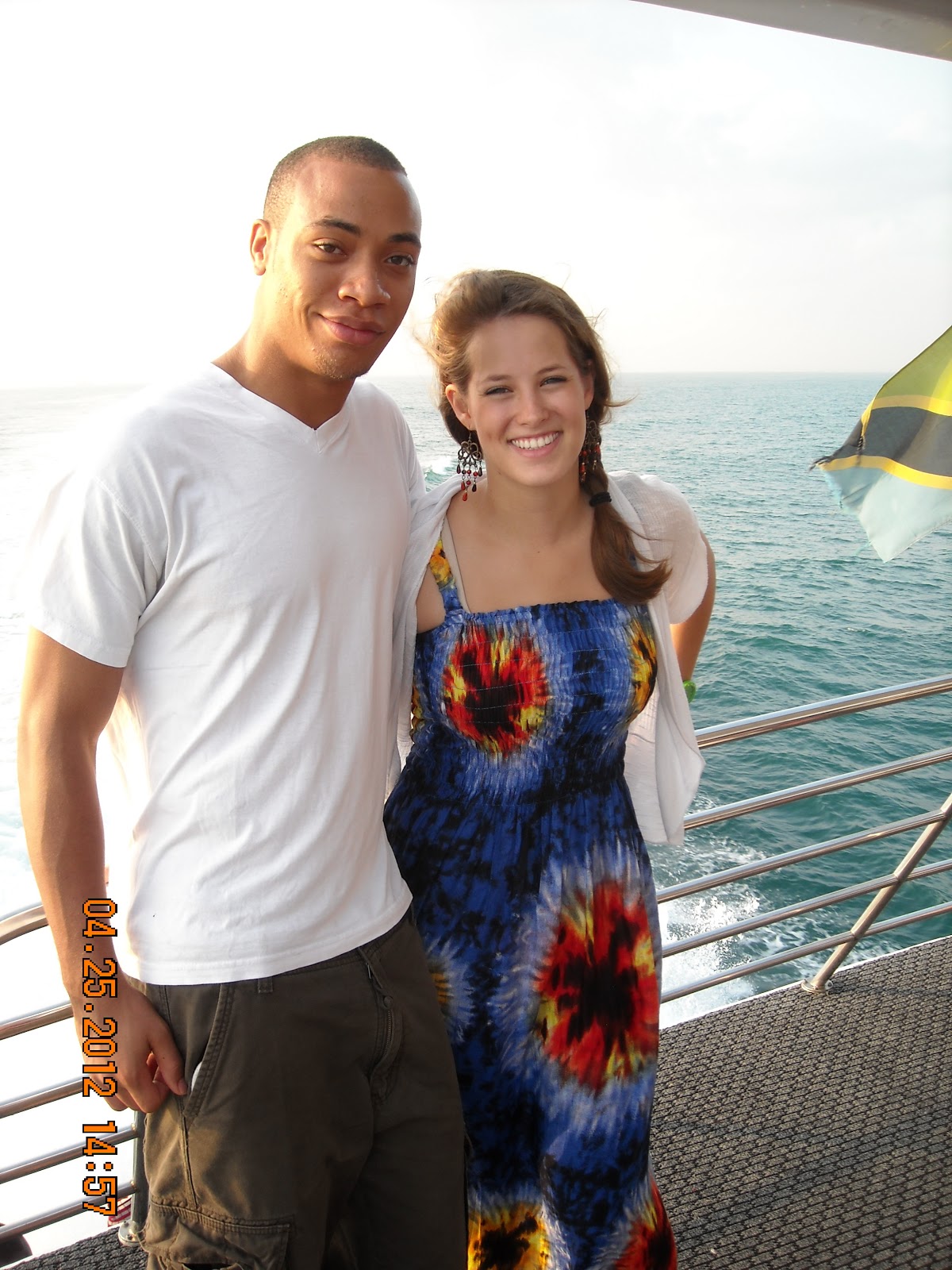
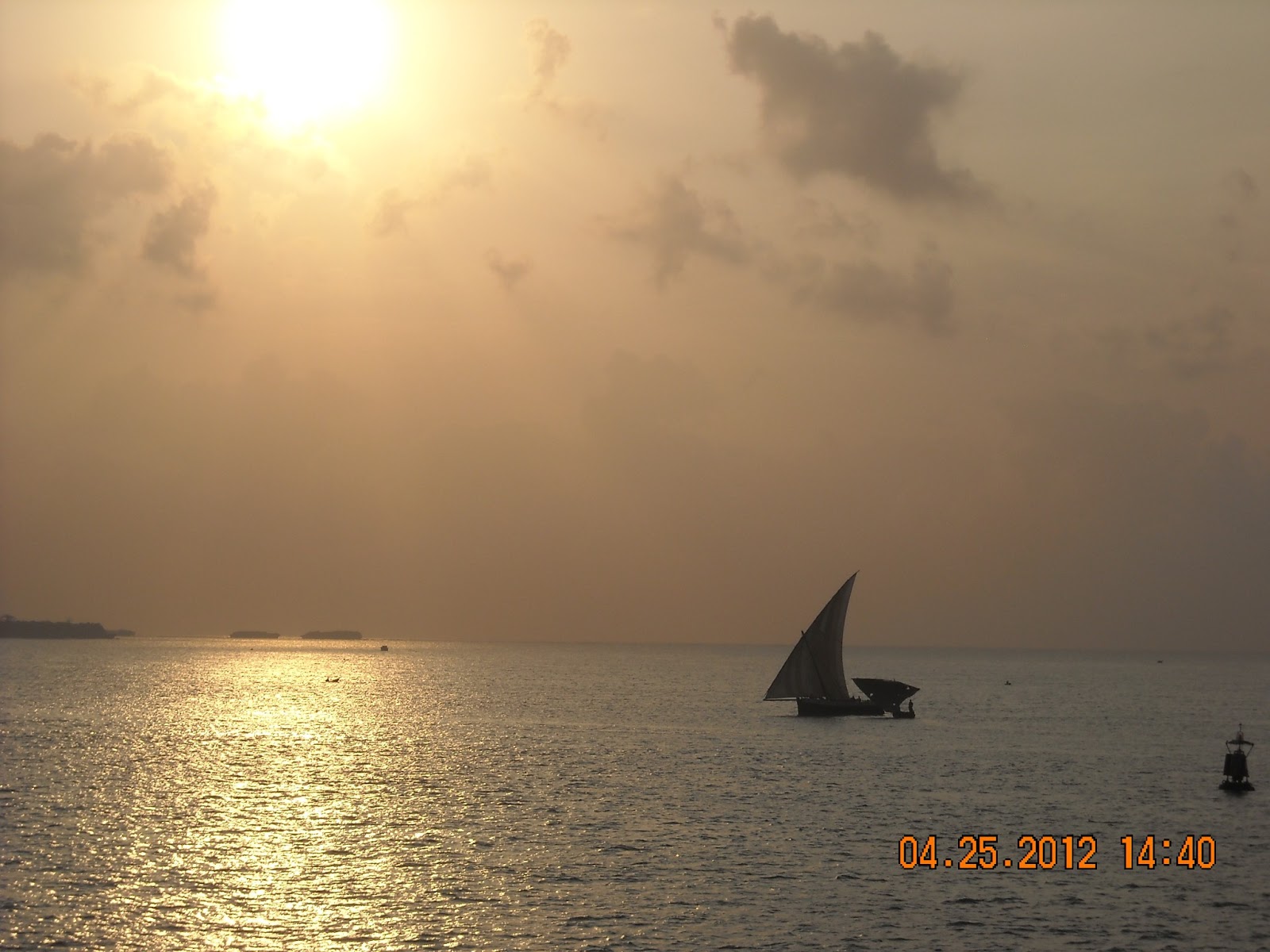
    Early morning, and I mean early, we left for Zanzibar even more tired than we thought possible. The boarding process was fast and before we knew it we were crossing the Indian Ocean. The sun raising was an absolutely beautiful scene. With the Dao boats sailing in view, it was reminiscent of something I would see in an anime (please excuse the geek out). 


View of Zanzibar from our hotel balcony. Photo; courtesy of Ali Anger.
Zanzibar as our ferry docked
The two hour boat ride took its time and I as well as many of the group dozed off mid trip. As we arrived we saw a few of the fifty isles that make up Zanzibar just before Unguja came into view. The boat docked and after a short time of waiting for our information to be processed we waltzed into Stone town a combination of Old and new (the city is literally split into an old and new district). Our hotel was seconds away from the dock and located in the old potion of Stone town. We stayed at a three star hotel, which was very accommodating as well as luxurious, called Zanzibar Grand Palace. After settling to our gorgeous rooms we were sent away by our professors to tour the city while that caught up on some rest.  The quaint design of our side of town was absolutely entrapping, I was in love. While touring the city we saw many of the famous doors of Stone town, said to directly reflect the owner’s wealth and position during Arabic control. The tour also took us through the local markets, a few historic areas, and the best place for to watch the sunset in Zanzibar: Africa House Hotel.

The rest of the day was spent in the museums of Zanzibar we learned of the Arabic and Muslim influence and rule. One particular museum “The house of Wonder” I enjoyed the most it featured economy, biology, and an extensive history selection. The house of wonder this particular day housed an extra wonder. It was while touring the museum I met the internationally established Zanzibarian designer Farouque Abdela known for his disputed work with Princess Diana, as well as his work with Maya Angelou, the first lady of Tanzania and many Actors and actresses. We met and made a plan to meet at a later date for an interview, putting the close on a productive and quite auspicious day.

At the end of the tour and the day we were exhausted the few hours we had of down time were literally spent “down” we needed to catch up on some rest. We enjoyed dinner that night on the rooftop of our hotel. There we had an amazing view of the town to match the amazing cuisine served.

Wednesday the group and I traveled to the spice tour. The farm growing the spices had an extremely large variety of plants from spices and perfumes to fruits. We were shown many varieties and were given explanations of uses and side effects of many plants. At the end of the tour the farmers allowed us to taste many of the indigenous fruits growing in the farm. My particular favorite was the African Grape fruit. However, my pleasure was ruined by the infamous Durian Fruit A.K.A the stink fruit. The smell was absolutely abysmal yet everyone I had talked to about it told me it tasted heavenly…it was a trap. After tasting the fruit I was nauseous for the next two days. Tasting of the durian fruit concluded the tour, especially for me and we returned to Stone town after purchasing spices. And this was only the morning.
Variety of spices for sale after our spice tour. Courtesy of Ali Anger

Snorkling!!! Courtesy of Ali A.
Our afternoon was spent snorkeling in the Indian Ocean. It was my first time and I was very excited for the experience. After taking a ferry out to the reef we jumped in without hesitation. Unfortunately due to my lack of experience the first fifteen minutes I spent drowning… drowning really well. But after adjusting to the gear, seeing the reef and fish was quite nice.

Dinner during Zanzibar black out Courtesy of Ali Anger :)
That evening we were preparing to walk the town in search of a nice restaurant when the power turned went out. The streets were pitch black, after some speculation, we opted for adventure. Chris and I gathered some flashlights and we made our way down the street until coming upon a small park with many vendors hosting fresh caught seafood such as lobster, muscles, and fish. The variety was ridiculous we took our time reviewing the food and took to bartering with the locals for dinner. Afterwards we enjoyed drinks with a local in the labyrinth alley streets of Zanzibar.

Our third and final day in Zanzibar we went to the beach. I figure I’ll let the pictures speak for themselves for this period of the trip.
Bruce, Brooke, and I building our sand castle

After a long day at the beach we returned home to shower and prepare for dinner. Chris and I had a dinner date with his mother, aunt, and some family friends, while the rest of the group enjoyed dinner back at the hotel. This evening we went out to commemorate the end of our trip to Zanzibar…We won’t discuss the matters of this particular night…

The following morning was…difficult. Chris and I had to get up early with the rest of the group to switch our Ferry tickets to a later time. We both had made plans for the morning. I had my interview with Farouque and Chris had plans with his aunt and mother.


After my interview with Farouque Abdela I met with Chris, his mother and Aunt for some lunch. They then walked us to the harbor and we left Zanzibar…But after experiencing Zanzibar I will most definitely return.